There is no single best sound healing course in India. The best one for you depends on what you want from it.
If you want to guide sessions yourself, look for a course with long hands-on practice time, instruments provided, small groups, and a certificate that reflects real supervised practice. If you only want to experience sound healing first, a short workshop or a single sound bath may be enough, and a full sound healing teacher training would be more than you need.
This guide gives you the checklist to compare courses honestly, so you can judge any sound healing training in India, including our sound healing course in Goa, on the same points.
This post is a comparison guide only. It helps you compare sound healing courses. The training itself, and all booking, live on the Sound Healing course page.
What “best” really means
Most “best course” lists online rank schools without explaining how they chose them. Some are written by the schools themselves. A useful comparison looks different.
Start with your goal. There are three common ones:
- Deepen your own practice and experience sound work properly.
- Add sound healing to yoga classes, meditation sessions, or wellness work you already do.
- Begin guiding sound healing sessions for others, one to one or in groups.
Each goal needs a different depth of training. A weekend workshop can serve the first goal. The second and third goals need supervised practice time, because guiding others is a practical skill, not something learned from theory alone.
Seven things to compare before you book
1. Hands-on practice time
Ask how much of the sound healing teacher training is spent actually playing the instruments, not listening to lectures about them. Playing a singing bowl well needs repetition: holding, striking, rim playing, and learning how tone, intensity, and rhythm change the experience.
A singing bowl course that teaches around 30 practical techniques with daily practice gives you far more usable skill than one that covers the same ideas in slides.
2. Which instruments you learn, and whether they are provided
Himalayan singing bowls are the central instrument in most serious trainings. A focused Himalayan singing bowls training puts them at the centre of daily practice. Gongs, bells, chimes, tuning forks, and voice often appear as complementary tools.
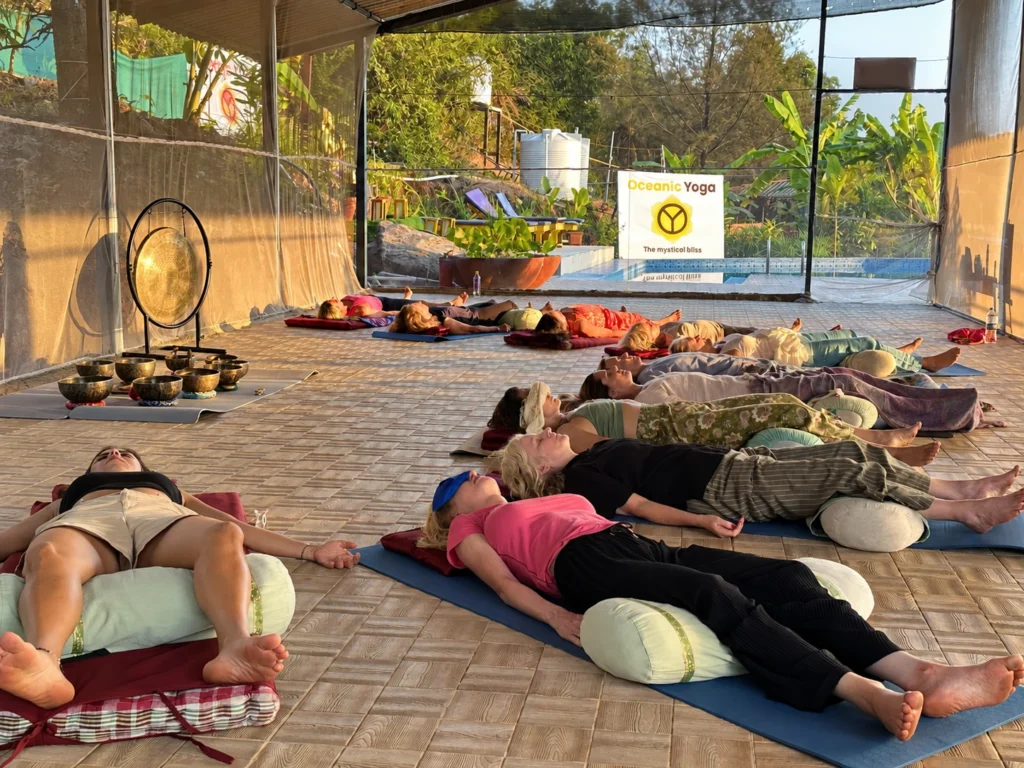
Ask whether instruments are provided during the course. If you must buy a bowl set before you arrive, that adds cost and a decision you may not be ready to make. At our Goa training, bowls and course instruments are provided, so sound healing for beginners starts without buying anything.
3. Integrated training or small levels
Some schools split sound healing into Level 1, Level 2, and Level 3 weekend courses. Others teach it as one integrated residential programme, moving from foundations into technique, applied protocols, individual sessions, group sound baths, and teaching foundations in a single arc.
Neither model is automatically better. But check what each level actually qualifies you to do, and what the full path costs in total, before comparing prices.
4. What the certificate really means
Ask who issues the certificate and what it reflects. A certificate for attending a weekend is not the same as sound healing certification after supervised practice and assessment.
Our Goa training provides Oceanic Yoga certification on successful completion, reflecting the pathway you trained in. Be careful with any course that promises a clinical or medical qualification. Sound healing training in the yoga and wellness field is not clinical music therapy, and honest schools say so plainly.
For a deeper look at what certification usually covers, see our complete guide to sound healing certification and teacher training.
5. Group size and individual attention
Sound work is personal. In a very large group, you may watch demonstrations without enough turns holding the instruments yourself.
Ask for the maximum group size. Our Goa training caps groups at 18 students, which keeps practice time and feedback realistic.
6. Residential, online, or weekend format
India offers all three, and each suits a different life:
- Residential trainings in places like Goa, Rishikesh, and Pune give you daily rhythm, practice, meals, and community in one place. They suit people who can travel for one to two weeks.
- Online courses suit people who cannot travel, but check how practice is supervised through a screen.
- Weekend workshops suit a first taste, but rarely give enough practice to guide sessions confidently.
Auroville is known for community based sound work, Rishikesh and Pune have established schools, and Goa has residential trainings by the sea. The city matters less than the practice time, the teachers, and the format that fits your life.
7. Total cost, not just the headline price
Compare what is actually included: accommodation, meals, study materials, instruments during the course, and certification. A lower headline price can cost more once rooms, food, and instrument hire are added.
Ask for the full price by room type before you decide. For reference, our Goa training for published 2026 to 2027 cohorts runs from 797 euros on the Ashtanga pathway (11 days, 10 nights) and from 847 euros on the Yin pathway (12 days, 11 nights), with accommodation and vegetarian meals included in the residential package.
Questions to ask any school before you book
- How many hours will I spend playing instruments myself?
- Are instruments provided, or must I buy them?
- What does the certificate reflect, and who issues it?
- What is the maximum group size?
- What is included in the price, and what is separate?
- Will I practise guiding a full session, one to one and in a group, before I finish?
- Is this training presented as clinical therapy, or as yoga and wellness based practice?
A good school answers these plainly. Vague answers are information too.
Red flags worth noticing
- Guaranteed healing results for any condition. Sound healing is commonly experienced as calming and meditative, and it complements rather than replaces medical care.
- A certificate promised with almost no practice time.
- Prices that hide accommodation, meals, or instrument costs until after you apply.
- No chance to ask who teaches, or what their background is.
- Pressure to book today for a discount that never ends.
Where our Goa training fits
If your goal is to learn sound healing properly and begin guiding sessions, our residential sound bath training in Morjim, North Goa, is built around practice. The programme covers the foundations of sound and vibration, Himalayan singing bowl technique, around 30 practical techniques, applied protocols, working with and around the body, individual sessions, group sound baths, meditation and breath integration, and the foundations of teaching.
You choose one of two pathways, and the sound healing curriculum is identical on both. The Ashtanga pathway pairs the training with structured, movement based practice over 11 days and 10 nights. The Yin pathway pairs it with slower, stiller practice over 12 days and 11 nights. Beginners are welcome on either pathway, and no prior sound healing qualification is needed.
You can read the full programme, dates, and prices on our Sound Healing Teacher Training in Goa page.
Before you choose
The best sound healing course in India is the one that matches your goal, gives you real practice time, states its costs honestly, and teaches within its proper scope.
Use the checklist above on every school you consider, including ours. Then choose the training where you will actually play, practise, and be guided, not just the one with the strongest claim on a list.
Remember: this guide only helps you compare courses. The training itself, with its dates and all booking, lives on the Sound Healing course page.
If a residential training in Goa fits your goal, our Sound Healing Teacher Training in Goa page has the dates, pathways, and room prices.
If you want to understand the science behind the practice first, start with our existing guides to the science of sound healing and to what to expect in a first sound healing session.
Frequently asked questions
What is the best sound healing course in India for beginners?
A course designed for sound healing for beginners starts from the foundations, provides the instruments, and gives you supervised practice time before any teaching practice. Avoid courses that assume you already own bowls or already play.
How long does a sound healing teacher training take?
It varies. Weekend workshops take two days. Integrated residential trainings in India commonly run 11 to 12 days, which allows daily practice plus time to learn session structure and facilitation.
Do I need to buy singing bowls before a course?
Not always. Ask the school directly. At our Goa training, bowls and course instruments are provided, so you can learn first and decide about buying later.
Is sound healing certification the same as music therapy?
No. Sound healing teacher training in the yoga and wellness field is not a clinical music therapy qualification. It trains you to guide sound based practice within a wellness scope, not to treat medical conditions.
Is Goa a good place to train in sound healing?
Goa suits people who want a residential setting with daily practice, sea air, and time away from routine. Rishikesh, Pune, and Auroville each have their own strengths. Choose by training quality and format first, and by place second.
How much does a sound healing course in India cost?
Prices vary widely by length, location, and what is included. Always compare the total package: tuition, accommodation, meals, materials, instruments, and certification. Our Goa training starts from 797 euros for the Ashtanga pathway and from 847 euros for the Yin pathway, with accommodation and vegetarian meals included.