
A student may look calm and still feel overwhelmed. Another may need more choice, more space, or simply a different way of being invited into practice. For teachers, the question becomes more than “How do I teach this pose?” It becomes, “How do I teach the person in front of me?”
That question is at the heart of our 200-hour Nervous System Regulation and Trauma-Informed Yoga Teacher Training in Morjim, Goa — a residential training that brings together yoga, trauma-aware teaching, somatic movement and accessible nervous-system education, so practice can be offered with greater choice, sensitivity and understanding.

The piece most teacher trainings skip
Most teacher trainings teach you poses, alignment and sequencing. Those matter. But they do not explain what you meet in a real classroom: students with very different relationships to stress, challenge, stillness, touch and their own bodies.
A student who cannot settle in savasana is not necessarily doing it wrong. A student who goes quiet, or restless, or suddenly tearful during a slow practice is not necessarily failing at yoga. Often, something older and deeper is happening in the nervous system — and a teacher who can recognise that, without diagnosing it or trying to fix it, teaches a very different class.
This is the angle other trainings largely ignore. We built this training around it — not as a single lecture added to a standard course, but woven through the whole programme.
The nervous system, in plain language
You do not need a science degree to use this knowledge, and this is not a clinical neuroscience course. Scientific ideas are taught at the level useful to yoga teachers: clearly, practically, and with appropriate limits.
In simple terms, the nervous system moves between states. There is a state of safety and connection, where we can learn, relate and rest. There is a state of activation, where energy rises for challenge or stress.
And there is a state of shutdown, where the system pulls back and goes quiet. Every student moves between these states, sometimes within a single class.
Three ideas from the training help teachers work with this:
The window of tolerance. A non-diagnostic teaching lens for pacing, intensity and choice. When a practice stays within a student’s window, they can stay present and learn.
When it pushes past it, they either speed up into overwhelm or shut down. A teacher who understands this paces a class differently — offering options, watching intensity, and never treating endurance as proof of depth.
Interoception. Sensing, interpreting and integrating signals arising from within the body. Much of yoga is interoception training by another name: noticing breath, sensation, heartbeat, tension, ease. When teachers understand it, they can guide attention with more precision and less pressure.
Co-regulation and presence. Voice, pace, predictability, boundaries and relational presence. A teacher’s steadiness affects the room — not because a teacher controls anyone else’s nervous system, which no one can claim, but because a calm, predictable presence gives students something safe to settle beside. This is also why the training itself is residential: you learn co-regulation by living it, not only by reading about it.
We also teach polyvagal-informed perspectives — the framework developed by Dr. Stephen Porges, including the three states described above — with acknowledgement of the active scientific debate around aspects of its interpretation. Honesty about what is settled and what is still debated is part of teaching responsibly.
What trauma-informed really means — and what it does not
Trauma-informed teaching rests on a few clear principles: choice, consent, predictability, options and respect for autonomy.
In practice, that looks like invitational language instead of commands. It looks like offering options rather than a single correct version of a pose. It looks like consent and boundaries around touch, predictable pacing and transitions, and a class structure students can rely on from day to day.
It does not mean turning yoga into therapy. The role of the yoga teacher remains the role of a yoga teacher. “Trauma-sensitive yoga” is used in different ways across the field, including specific evidence-informed and clinical programmes, and it should not be reduced to meaning one-to-one therapy.
Our focus is responsible, trauma-informed yoga teaching — and knowing when something belongs outside a teacher’s scope. If a student needs more help than yoga can offer, a good teacher knows how to refer, not how to intervene.
That distinction protects everyone: the student, the teacher, and the practice itself.
Looking for a personal, healing-focused stay rather than teacher training? Our Emotional Healing Retreat in Goa was created for exactly that.
How it shows up in the training
This is a 200-hour residential training, run over 23 days and taught in person at our school in Morjim, North Goa, in small groups of no more than 18 students. Nervous-system awareness and trauma-informed teaching are woven through the programme rather than treated as a single add-on topic.
A day moves between practice, understanding and integration. Mornings begin in the body — asana, kriya, mantra, pranayama and meditation — so concepts are felt before they are analysed. Mid-mornings turn to anatomy, alignment and embodied study, connecting nervous-system ideas with what you actually notice in practice.
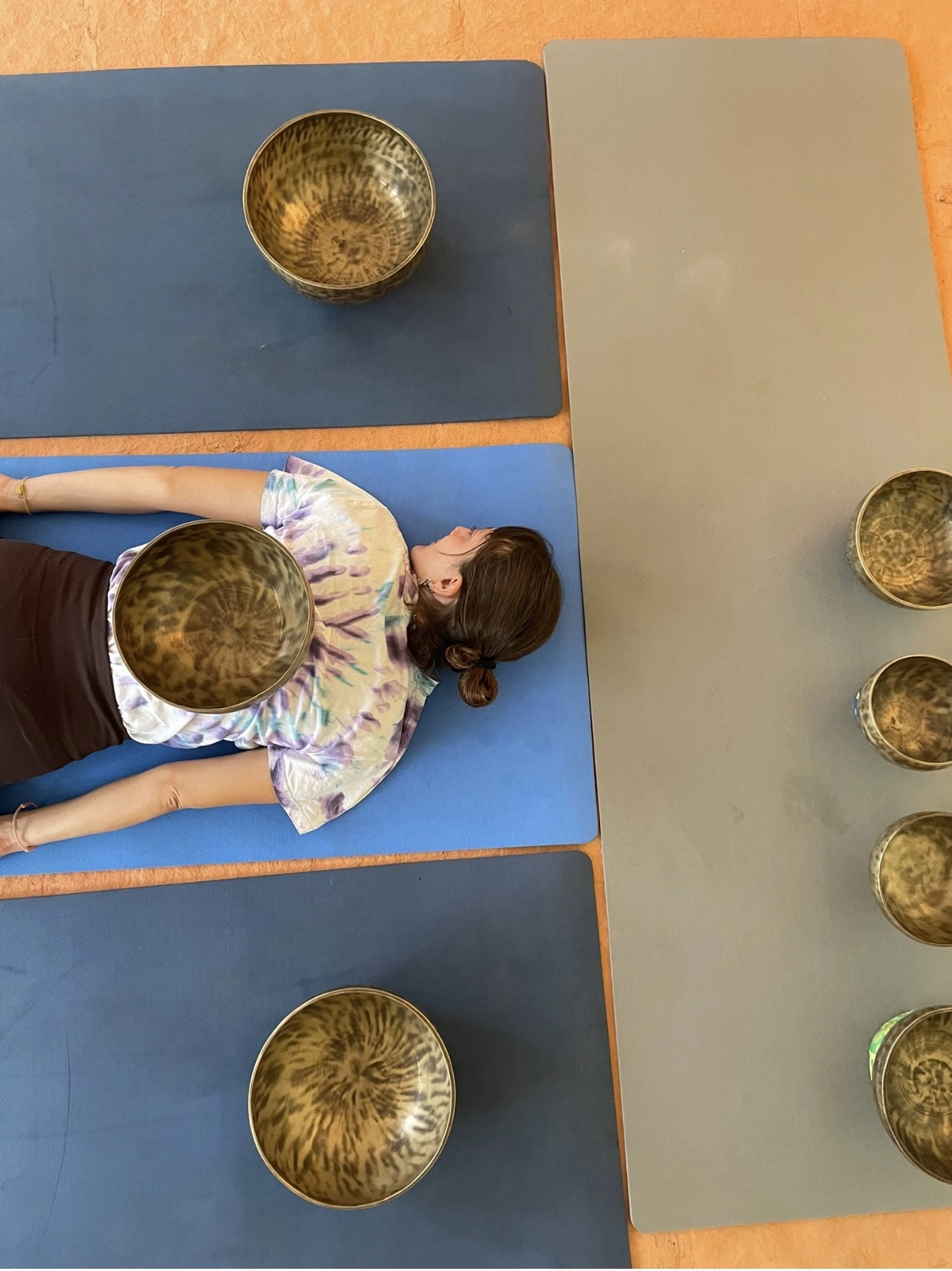
Afternoons bring philosophy into conversation with choice, consent, boundaries, cueing, sequencing and professional scope, and ask how these principles change ordinary decisions in a real class. Evenings close with meditation, Yoga Nidra, breathwork, sound or other contemplative practices, with the emphasis on noticing effects without turning a felt response into a universal promise.
Across the training, twelve connected strands form one integrated way of teaching:
- nervous system regulation
- trauma-informed yoga
- trauma literacy
- somatic movement
- polyvagal-informed teaching
- Yin yoga
- Yoga Nidra
- breathwork and pranayama
- sound healing
- meditation and mindfulness
- restorative yoga
- teaching methodology
You will also explore and learn to teach practices for regulation:
- slow diaphragmatic breathing
- extended-exhale breathing
- gentle forward folds
- humming and chanting
- restorative and Yin postures
- Yoga Nidra
These practices may influence how settling and arousal are experienced, but they are not presented as direct vagus-nerve treatment or as trauma therapy — a limit we state plainly, because responsible teaching starts with honest claims.
By the end, five skills should feel natural in your teaching:
- invitational and choice-centred language
- consent and boundaries around touch
- pacing, transitions and predictability
- observation without diagnosis
- referral and scope awareness
Who this training is for
The yoga teacher who wants to teach with greater sensitivity, choice and confidence.
The wellness professional who wants an embodied understanding of stress, attention and supportive practice, within their own professional scope.
The curious practitioner who wants to understand body, inner states and yoga practice from a wider perspective.
The person in transition who wants space for study, self-exploration and a change of rhythm.
Some come to teach. Others come to understand themselves, reset, or spend a meaningful period in sustained practice and inquiry. Different reasons, and a shared curiosity about the whole human being.
Why learn it here, in Morjim
Living and studying on campus creates continuity between practice, discussion, feedback, rest and the relationships that develop across the training. Concepts move into breath, movement, stillness, observation, teaching language and practicum, so they can be experienced as well as understood.
The setting helps: an open-air practice environment, vegetarian meals, a swimming pool, and around ten minutes from Morjim Beach, with nature, shared meals and pauses away from ordinary routines giving the work space to settle. Small enough to be seen — that is how a training about presence should feel.
Frequently asked questions
What is nervous system regulation in yoga teaching?
It is understanding how stress, safety, resilience and regulation shape a student’s experience in class, and using practical tools — breath, pacing, language, choice — that support balance. It is taught at a level useful to teachers, not as clinical science, and it comes without medical promises.
What does trauma-informed yoga mean?
It means teaching with choice, consent, predictability, options and respect for autonomy. Students are offered options rather than ordered into a single version of a pose, touch happens only with consent, and the class follows a predictable rhythm students can trust.
Is trauma-informed yoga the same as therapy?
No. The teacher’s role stays the teacher’s role. Trauma-informed teaching helps you recognise when a student is struggling and respond with care, and it helps you know when something belongs outside your scope and needs a referral.
Do I need to be an experienced teacher to join?
The training is designed for yoga teachers, wellness professionals, curious practitioners, and people in transition. Some participants come to teach, others come to understand themselves and spend a meaningful period in sustained practice. No background in psychology or healthcare is required.
What practices will I learn?
Slow diaphragmatic breathing, extended-exhale breathing, gentle forward folds, humming and chanting, restorative and Yin postures, and Yoga Nidra — each explored through the lens of how settling and arousal are experienced, and how to teach them with choice and pacing.
Is this a clinical neuroscience course?
No. Scientific ideas are taught clearly and practically, at the level a yoga teacher can actually use, with appropriate limits. Polyvagal-informed perspectives are included, with acknowledgement of the active scientific debate around aspects of their interpretation.
How is this different from a standard 200-hour training?
In a standard 200-hour training, nervous-system and trauma-informed ideas, if they appear at all, are usually a single topic. Here they are woven through the whole programme — through philosophy, methodology, practice, language and teaching practicum — alongside Yin, Yoga Nidra, breathwork and sound healing.
What is co-regulation, and why does it matter in a class?
Co-regulation is how a teacher’s voice, pace, predictability, boundaries and presence help create a room where students can settle. A teacher cannot control another person’s nervous system, but a steady, predictable presence gives students something safe to settle beside.
Why do some students struggle with savasana or stillness?
Stillness and inward focus are experienced differently by different people. For some, lying still feels restful; for others it feels exposed or overwhelming. This training teaches alternatives, options and pacing so rest is offered as a choice, never forced.
What if a student needs more help than yoga can offer?
Then the teacher’s job is to recognise that and refer. Observation without diagnosis, and referral and scope awareness, are core skills in this training — knowing the edge of your role is part of teaching well.
Where does the training take place?
At our residential school in Morjim, North Goa, taught in person in small groups of no more than 18 students, with open-air practice, vegetarian meals and time in nature built into the rhythm of each day.
What certification will I receive?
On successful completion, you receive a 200-hour Yoga Alliance accredited certificate from Oceanic Yoga, along with a complimentary lifetime RYT 200 membership with the International Yoga Association. You can also separately register as an RYT 200 with Yoga Alliance to teach worldwide.
Dates and investment
This is a 23-day residential training at our school in Morjim, North Goa. Verified room prices: Triple Share €1,597 per person; Twin Share €2,097 per person; Private Room €2,697 per person. All rooms are air-conditioned with a balcony, subject to availability, and vegetarian meals are included per the published schedule. A €400 booking amount secures your place — non-refundable but transferable, adjusted against the total course fee.
Upcoming batches:
- 26 October – 17 November 2026 (6 places left)
- 18 November – 9 December 2026
- 10 December 2026 – 1 January 2027
Prices and dates are subject to availability — see the course page for the latest batches.
If this is the teacher you want to become, the next step is to read the full training page.